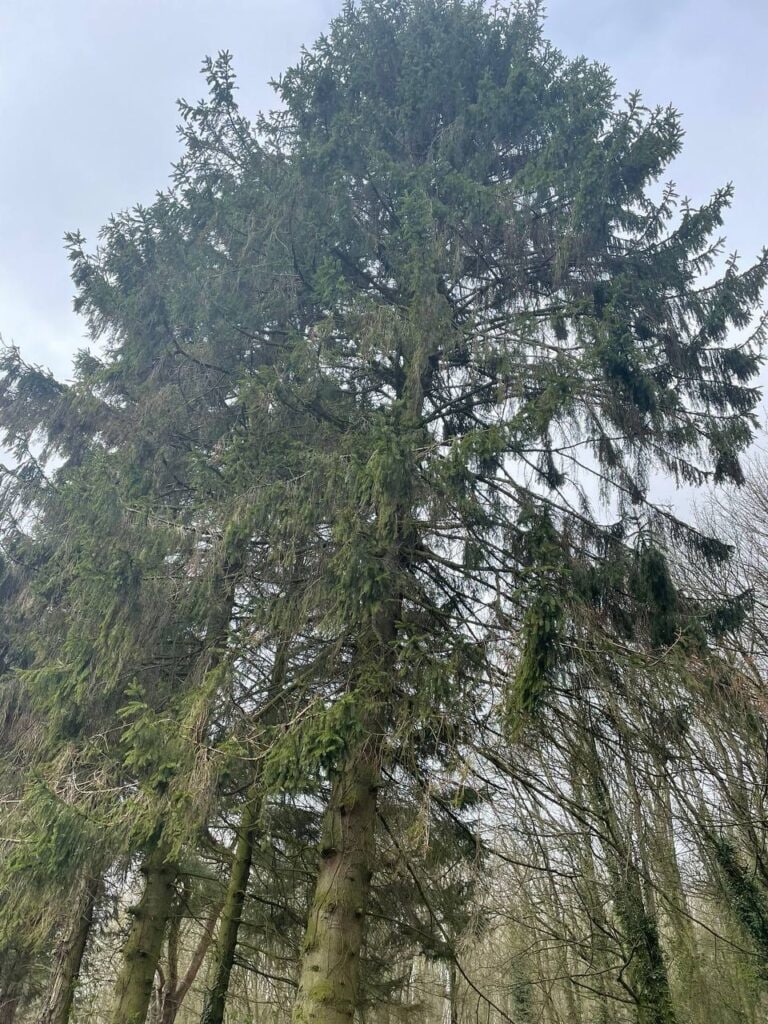
Trees naturally become larger as they mature, but there can come a point when the size or shape of a tree begins to create practical difficulties within a garden. Long branches may extend across lawns or paths, lower growth can reduce clearance, and an expanding crown may occupy considerably more space than it once did.
An overgrown tree does not automatically need to be removed or severely cut back. Where the tree remains suitable for retention, professional tree surgery can often target the specific growth responsible for the problem. Depending on the tree and the desired result, this might involve crown reduction, selective pruning, crown lifting, crown thinning or the removal of dead and damaged branches.
For homeowners in Paddock Wood, Kent, the most appropriate approach begins with understanding why the tree has become difficult to manage. Professional assessment allows the work to be matched to the tree’s condition, structure and surroundings rather than simply removing as much growth as possible.
How Can Professional Tree Surgery Make an Overgrown Tree More Manageable?
Tree surgery is particularly useful where an established tree remains suitable for its location but particular parts of its crown have become excessive or inconvenient.
Professional tree surgery may be considered when:
- The crown has become too large for the available space
- Individual branches extend significantly beyond the main canopy
- Lower branches restrict movement beneath the tree
- Growth is encroaching on frequently used garden areas
- The crown has developed unevenly
- Dead or damaged branches require attention
- Previous pruning has resulted in dense or awkward regrowth
- The tree needs managing while retaining suitable healthy growth
- Several specific branches are causing problems
- Removal would be unnecessary because the tree can be managed appropriately
The important point is that different problems require different tree surgery techniques.
An Overgrown Tree Is Not Necessarily an Unhealthy Tree
Large size and poor condition are not the same thing.
A healthy mature tree can simply outgrow the space that was previously available around it. As branches extend and the crown develops, the relationship between the tree and the garden can gradually change.
This can create practical problems even when the tree itself remains in reasonable condition.
Tree surgery can therefore be about managing dimensions and structure rather than treating disease or deterioration.
Start With the Actual Problem
Before pruning begins, it is useful to identify what has made the tree difficult to accommodate.
The problem may be overall crown size, but it could equally involve only a few overextended branches.
Lower limbs might be obstructing access while the upper crown remains suitable. Alternatively, one side of the canopy may have developed disproportionately.
Identifying the problem first allows the tree surgery to remain focused.
Without a clear objective, unnecessary branches may be removed without providing a meaningful improvement.
Crown Reduction Can Manage Excessive Size
Crown reduction can be useful where the overall height or spread of a tree has become excessive for its surroundings.
The technique involves reducing appropriate parts of the canopy while maintaining a suitable overall form.
It should not be confused with simply cutting every branch back by the same distance.
The existing branch structure needs to guide where cuts are made and how much reduction is appropriate.
A well-considered crown reduction aims to make the tree more manageable while retaining a balanced canopy.
Crown Reduction Should Have a Clear Purpose
Not every mature tree needs reducing.
A tree can be large without being unsuitable for its location.
Crown reduction becomes more relevant where excessive dimensions are creating an identifiable problem, such as branches extending substantially across a garden or the canopy becoming disproportionate to the available space.
Pruning simply because a tree has reached mature size can result in unnecessary intervention.
Professional assessment helps determine whether reducing the crown will actually improve the situation.
Selective Pruning Can Be More Appropriate Than Reducing the Whole Crown
Sometimes only one or two parts of a tree are causing difficulties.
For example, a branch may have extended significantly across a lawn while the remainder of the crown remains appropriate.
In this situation, selective pruning may provide a more proportionate solution than reducing the entire tree.
Targeting the problematic growth allows suitable healthy branches elsewhere to remain undisturbed.
This can preserve more of the tree’s established character while still addressing the reason work is required.
Crown Lifting Can Improve Clearance Beneath a Tree
An overgrown tree may feel intrusive because of low branches rather than excessive overall size.
Where appropriate, crown lifting can manage selected lower growth to provide greater clearance beneath the canopy.
This can help where branches are interfering with paths, lawns or frequently used garden areas.
The upper crown can often remain largely unchanged.
Crown lifting should still be proportionate, as removing excessive lower growth can alter the tree’s natural balance and appearance.
Better Clearance Can Recover Usable Garden Space
Low and spreading branches can gradually make areas beneath a tree difficult to use.
A lawn may technically remain the same size, but low growth can make part of it feel inaccessible.
Targeted tree surgery can sometimes restore practical clearance without dramatically changing the complete canopy.
This can be particularly useful where retaining the established tree is desirable but its relationship with the garden needs improving.
Crown Thinning Is Different From Crown Reduction
Crown thinning and crown reduction are sometimes treated as though they are interchangeable, but they have different purposes.
Reduction alters the external dimensions of the crown.
Thinning selectively removes suitable internal branches while generally retaining the overall height and spread.
This means crown thinning is not normally the answer where the main problem is simply that the tree has become too wide or tall.
Choosing the correct technique avoids unnecessary pruning that fails to solve the original problem.
Deadwood Removal Can Be Carried Out Separately
An overgrown tree may also contain dead branches.
Deadwood removal focuses on identifying and removing appropriate dead growth rather than reducing healthy sections unnecessarily.
The presence of deadwood does not automatically mean that the entire crown requires substantial pruning.
Separating the different objectives allows the work to remain proportionate.
Healthy branches can then be considered according to their own condition and position.
Damaged Branches May Need Targeted Management
Storms, previous branch failure or other physical damage can leave individual sections of a tree requiring attention.
Where damage is localised, professional tree surgery may be able to focus on the affected branch.
The complete crown should still be assessed.
A damaged limb may have changed the balance of surrounding growth, or another branch may have begun developing into the space previously occupied by the lost section.
Considering these relationships can produce a better result than treating the damaged branch in isolation.
An Uneven Tree May Need Selective Rather Than Symmetrical Pruning
Trees do not naturally develop as perfectly symmetrical shapes.
Available light, surrounding features, previous pruning and branch loss can all influence crown development.
One side may therefore become more extensive than another.
Where this creates a practical problem, selective pruning can focus on the disproportionately developed section.
The objective should not necessarily be to create artificial symmetry.
Instead, pruning should improve the relationship between the crown, its structure and the available surroundings.
Previous Pruning Can Affect How a Tree Becomes Overgrown
Some overgrown trees have previously received substantial pruning.
Depending on the tree, heavy cutting can encourage vigorous new shoots around previous pruning areas.
These shoots can eventually create dense or awkward growth if left to develop.
Simply repeating the same severe cutting may continue the cycle.
Professional assessment can consider how the tree has responded to earlier work and determine a more appropriate management approach.
More Pruning Is Not Automatically Better
Removing the maximum amount of growth can seem like the most effective way to deal with an overgrown tree.
However, trees can respond to substantial pruning by producing vigorous regrowth.
This can result in a tree that needs further attention sooner than expected.
Heavy pruning can also remove suitable branches that were not responsible for the original problem.
Professional tree surgery should therefore focus on what needs to be achieved rather than how much material can be removed.
Tree Surgery Can Help Recover Lawn Space
A spreading crown can gradually extend over a significant proportion of a lawn.
Where lateral branches are the main issue, selective reduction may help restore a better balance between the tree and open garden space.
The complete canopy does not necessarily need substantial reduction.
Assessing which branches are responsible for the encroachment allows the work to remain targeted.
This can make the garden more usable while retaining the established tree.
Overhanging Garden Paths Can Often Be Addressed Selectively
Branches extending across paths can reduce headroom and make everyday access inconvenient.
Suitable crown lifting or selective pruning may improve clearance without significantly changing the rest of the tree.
This is often more appropriate than treating the entire canopy as overgrown.
The finished clearance should also consider future development rather than simply removing the smallest possible amount at the time of pruning.
Tree Surgery Can Improve the Relationship With Planting Areas
Established branches can gradually extend over borders and other planted areas.
This may make the garden feel increasingly crowded.
Selective management can sometimes create clearer separation while retaining much of the existing crown.
The aim is not necessarily to prevent the tree from influencing surrounding planting altogether.
Instead, pruning can help maintain a more practical balance between established trees and other garden features.
Managing Shade Requires Realistic Expectations
Large tree crowns naturally influence how much direct light reaches the ground beneath them.
Tree surgery can sometimes alter this relationship, but severe pruning should not automatically be used simply to maximise light.
A mature tree will continue to provide some shade if it is retained.
Depending on the actual objective, selective management may provide an improvement without dramatically altering the crown.
Professional advice can help determine whether the desired result is realistic for the individual tree.
Crown Thinning Does Not Make a Tree Permanently Open
Where crown thinning is appropriate, selected internal branches may be removed to manage the canopy.
However, trees continue growing.
The crown will develop further after the work.
Tree surgery should therefore not be viewed as a permanent way of freezing a tree at one particular stage.
Future growth should form part of the management approach.
Different Tree Species Respond Differently to Pruning
Trees vary considerably in their natural form and response to pruning.
A technique that produces a suitable result for one species may not be appropriate for another.
This is particularly important when considering substantial crown work.
Professional tree surgery takes the characteristics of the individual tree into account rather than applying the same reduction to every overgrown specimen.
The tree’s existing condition and structure are equally important.
There Is No Universal Reduction Percentage
It can be tempting to decide that every overgrown tree should be reduced by a particular percentage.
In practice, suitable pruning does not work this way.
The appropriate amount depends on the reason for the work, available branch structure and how the tree can be pruned while retaining a suitable crown.
One tree may require relatively minor selective work, while another may benefit from a more noticeable reduction.
The amount should follow the tree rather than an arbitrary formula.
The Remaining Crown Matters as Much as What Is Removed
Good tree surgery is not only about deciding which branches to cut.
It also requires considering what will remain afterwards.
The retained branches form the future structure of the tree and influence how the canopy develops.
Removing branches without considering the resulting crown can produce an unbalanced or unnecessarily sparse appearance.
Professional pruning therefore considers the finished tree as part of the planning process.
Future Growth Should Be Considered Before Pruning
Tree surgery provides an immediate change, but the tree will continue developing afterwards.
This is particularly important with vigorous specimens.
A very severe reduction may create a dramatic short-term result but encourage substantial new growth later.
A proportionate approach considers both the current problem and likely future development.
This can make subsequent management more straightforward.
Regular Management Can Prevent Severe Overgrowth
A tree does not necessarily need frequent major pruning to remain manageable.
Periodic assessment can help identify overextended branches and developing problems before they become substantial.
Where suitable, smaller targeted interventions may be possible.
The appropriate interval varies between individual trees.
Regular management should therefore mean reviewing condition and growth when necessary rather than automatically carrying out heavy work every year.
Tree Surgery Can Help Retain Established Trees
One of the main advantages of appropriate tree surgery is that it can sometimes resolve practical problems without removing the complete tree.
An established specimen may contribute significantly to the character of a garden.
Where its structure and condition remain suitable, crown management can help adjust its relationship with the available space.
This can provide a useful middle ground between leaving problematic growth completely unmanaged and removing the tree unnecessarily.
Large Size Alone Does Not Mean Tree Removal Is Necessary
A tree should not be considered unsuitable simply because it is large.
The important questions involve its condition, structure, position and effect on its surroundings.
Where the main issue is manageable crown growth, professional pruning may provide an appropriate solution.
Tree removal becomes a different consideration where the tree cannot reasonably be retained or pruning cannot achieve the required result.
Assessment helps distinguish between these situations.
Tree Surgery Cannot Solve Every Tree Problem
Pruning has limitations.
Where a tree has significant deterioration or other substantial structural problems, simply reducing its crown may not provide an appropriate solution.
Likewise, problems originating below ground cannot necessarily be resolved through branch pruning.
Professional tree surgery includes recognising when pruning is useful and when another approach should be considered.
This avoids using crown work as a general solution regardless of the actual condition of the tree.
The Desired Outcome Should Be Agreed Before Work Starts
Tree surgery is most effective when there is a clear objective.
The homeowner may want more clearance, less lateral spread, improved access beneath the canopy or management of a particular branch.
Defining this outcome allows the work to focus on the relevant sections.
Without a clear objective, an overgrown tree may simply be cut back generally.
Targeted work usually provides a more meaningful result because every significant pruning decision has a reason.
Professional Assessment Helps Identify the Correct Tree Surgery Method
From ground level, different crown problems can look similar.
A dense tree may appear too large when its external dimensions are actually appropriate. A tree that seems generally overgrown may have only a few disproportionately long branches.
Professional assessment considers crown structure, dimensions, condition, previous pruning and surrounding space.
This helps determine whether crown reduction, lifting, thinning, selective pruning or another form of tree surgery is most appropriate.
Tree Surgery in Paddock Wood, Kent
For property owners in Paddock Wood, Kent, professional tree surgery can provide a practical way to manage an overgrown tree without automatically resorting to severe pruning or removal.
At PW Tree Surgeons, we can assess the tree’s crown, branch structure, condition and relationship with the surrounding garden before recommending suitable work.
Where individual branches are responsible for the problem, pruning can remain selective. Where the complete crown has become too large for its position, appropriate reduction may be considered. Where low growth is restricting space, crown lifting may provide a more focused solution.
The aim is to carry out proportionate tree surgery that addresses the actual problem while retaining suitable healthy growth wherever appropriate.
Conclusion
Tree surgery is often the best way to improve an overgrown tree when the tree remains suitable for retention but particular branches or parts of the crown have become difficult to accommodate.
Crown reduction can help manage excessive overall dimensions, crown lifting can improve clearance beneath the tree, and selective pruning can address individual overextended branches without unnecessarily altering the complete canopy. Dead or damaged growth can also be managed according to the condition of the tree.
Most importantly, an overgrown tree does not automatically require severe pruning or removal. The correct approach depends on its species, condition, structure, surroundings and the reason work is required.
If you have an overgrown tree at your property in Paddock Wood, Kent, contact PW Tree Surgeons. We can assess the tree and recommend appropriate tree surgery based on its existing condition, growth and relationship with the available space.
Call us on: 01892 352895
Click here to find out more about PW Tree Surgeons
Click here to complete our contact form and see how we can help with your tree needs.